
Trace Dickinson County Former Owners Transfer by Transfer
A backward transfer log anchors the whole table. Begin with the current deed, then work back one conveyance at a time until the chain of ownership runs out.
| Transfer date | Grantor to grantee | Deed type | Book/page or instrument |
|---|---|---|---|
| Newest known transfer | Prior owner to current grantee | As indexed | Copy from recorder result |
| Earlier transfer | Earlier grantor to prior grantee | As indexed | Carry forward exactly |
| Gap or non-deed event | Estate, court, or tax authority | Supporting instrument | Cross-reference the file |
This table tells a proved transfer apart from a directory or tax-roll clue. The Register of Deeds index supplies the recorded backbone.
Each deed entry there names the grantor and grantee. That chain beats any guesswork.
Move Dickinson County Previous Owners Across 1994
The recorder splits older and newer files at 1994. Recordings before that year sit in the tract index. Staff search it at $6.25 for every 15 minutes. Anything after 1994 lives in the computer index, and a search there runs $5. Copies cost $1 per page in either paper or PDF form. Ask the office to confirm current charges before you order anything.
The 1994 line is about access and fees. It is not a firm online cutoff for the records themselves. Dickinson County publishes no exact coverage date for its computer index. Ask the recorder what predates it. Then request a bounded tract or deed-book search for older parcel records.
Coverage limit. Do not turn the pre/post-1994 fee split into a false claim that every later deed is online or every earlier deed is unavailable.
Open the Dickinson County Deed Index
The official recorder portal allows document-number, name, and description searches; document images follow guest or member payment steps.
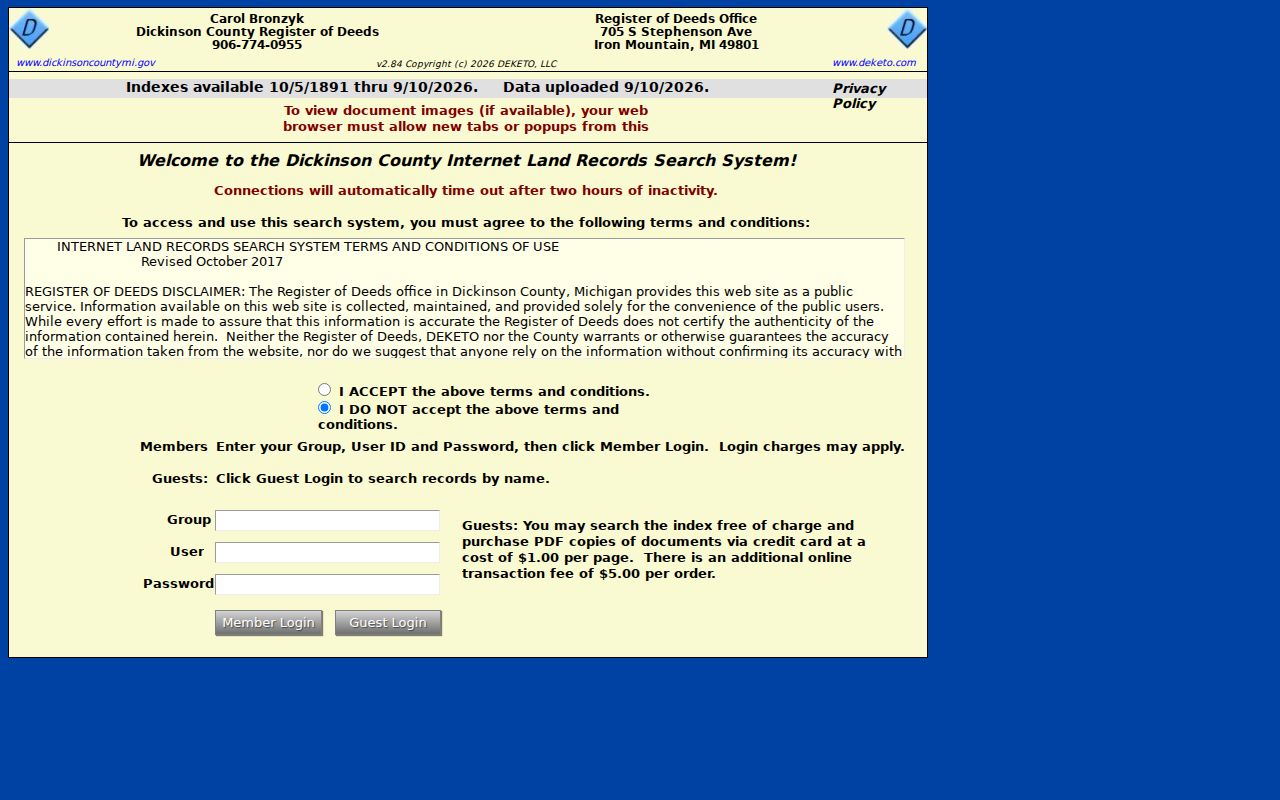
Write down the instrument number before you pay for any image. Then search both parties near the transfer date and check the legal description at every step as you work back through the deed chain.
Reconstruct the Dickinson County Deed Chain Backward
A reverse search works by treating each grantor as the next grantee one step earlier. Names alone will trip you up, though, because families, businesses, and common surnames repeat throughout Dickinson County deed records.
- Find the current owner's acquisition deed with that party as grantee.
- Copy the grantor, legal description, date, deed type, and instrument reference.
- Search that grantor as an earlier grantee and repeat the match.
- When computer results stop, continue through the tract index and deed books with recorder help.
- Grantor / grantee
- The transferring and receiving parties.
- Chain of title
- The ordered sequence of instruments affecting ownership.
- Reverse index
- A route from a party's name to earlier acquisition records.
- Warranty / quitclaim
- Different deed forms whose legal effect should not be guessed from the label alone.
Use Dickinson County Instrument Prefix Clues
The recorder's 2021 information sheet lists prefix clues worth learning. L stands for lien. S means survey. C marks a corner, E a mortgage, and M miscellaneous. These codes help you spot documents around a former owner's transfer. They also keep you from treating every indexed item as a deed.
Search the former owner and the legal description near each transfer date. Look there for mortgages, assignments, releases, surveys, and restrictions. Prefix conventions can change. Confirm current usage with the recorder's office before you rely on them for a property search.
Take Pre-1891 Dickinson County Owners to Predecessor Counties
Dickinson is Michigan's youngest county. It was organized in 1891 from parts of Marquette, Menominee, and Iron counties. Because of that, a property trail that starts before organization may sit under a predecessor county, depending on the era and where the land lay.
The Library of Michigan Dickinson guide points you to atlases, plats, directories, and newspapers. Follow each lead back to a recorded instrument. That county-formation story explains a gap in the deed records without inventing a lost deed.
Bridge Old Dickinson County Addresses and Parcels
A street address only points to a spot. The durable keys in Dickinson County deeds are the legal descriptions. These include subdivision or addition, lot and block, section-township-range, or metes and bounds. A parcel split or combination can mint a new parcel number. Older deeds still carry the parent description, so match on the land itself. The Norway directory from that era warns that street numbering was incomplete. Woodward-area properties carried both Kingsford and Iron Mountain labels. Before dismissing an older lead, search by person or business name, street, and addition across both municipalities. Check newspaper legal notices too.
Note: Keep old and new parcel numbers together when land-division records show that one modern parcel replaced several historic lots.
How Far Back Dickinson County Ownership Records Go
Dickinson County records start with its 1891 organization. The recorder keeps older tract material alongside later computer-search records. The office publishes no online coverage details, though. For an earlier chain of title, ask which deed books or tract indexes apply. Then extend the search into predecessor counties and historical collections.
Lawful use. Former-owner research supports house history, estate work, and purchase diligence; it must never be used to track, harass, intimidate, or harm a living person.
Document Dickinson County Prior Owners Without Guessing
For each former owner, record both names exactly as indexed. Add the recording date, deed type, instrument number or book and page, and the legal-description clue. A warranty or quitclaim label alone does not settle a transfer's legal effect. Pull the related instruments too. Mortgages, releases, land contracts, probate deeds, court orders, and tax conveyances often explain a change. A simple buyer-seller story misses it. Search a tight window around each purchase first. With a common name, add the addition or legal description and inspect neighboring instruments. A 2021 recorder sheet lists county document prefixes. L stands for lien, S for survey, C for corner, E for mortgage, and M for miscellaneous. Confirm current conventions before relying on them. When an interval stays unresolved, mark it as a gap. Never insert an assumed owner of record. Tax rolls and city directories can suggest who held a place at a given time. Treat them as leads only. The Library of Michigan guide notes Iron Mountain city directories survive incompletely from 1925 through 2018. It also lists newspapers, atlases, and plat books. Record the year and page for each hit. Then tie the name to a deed, probate instrument, or tax record for the same parcel. Do not call it proven until then.
Carry Dickinson County Former Owners Before 1891
Dickinson County was organized in 1891 from parts of Marquette, Menominee, and Iron counties. A prior-owner chain reaching back before formation may continue in a predecessor county. It depends on where the land lay and when the transfer occurred. Start from the original town plat or section description. From there, use tract indexes to keep the chain moving. Deed books, newspapers, and atlas or plat-book comparisons help as well.
The county Clerk holds local records from the county's founding. Older land history did not vanish; the jurisdictional label simply changed. Ask the recorder which predecessor index and book series applies. Preserve that answer with your chain of title.
A clean chain sometimes breaks at an estate. When it does, chase the death record first. Then look for the probate docket, the letters of authority, and the personal-representative or heir deed that moved the change back into the land records. The probate file shows who held authority to act, but it never replaces the recorded conveyance itself. Dickinson County's court map assigns probate matters to Probate Court, while the Register of Deeds holds the instrument that touches the parcel. When both records form one step in the chain, record both file references.
Tax foreclosure creates another break in routine. The Dickinson County Treasurer serves as the foreclosing governmental unit, so delinquency, forfeiture, foreclosure, auction, and excess-proceeds records all run through that office. Michigan law separates those stages. An early delinquent-tax entry is not itself proof that ownership changed. Capture the tax year, the forfeiture or judgment date, the redemption status, the auction or transfer record, and any later deed. Then read the chain backward from the completed recorded transfer. Do not slot the Treasurer in as an owner at every tax stage.
Historic plats keep the same land in view while names and addresses shift. A platted description may rely on subdivision or addition, lot, block, outlot, or replat terms. Rural land instead uses section, township, range, aliquot parts, acreage, or metes and bounds. Compare those components at every backward step. Watch for easements and restrictions too. An easement can be recorded without transferring the fee interest, so its parties do not belong in the ownership timeline just because their names sit beside the parcel description.
Dickinson's local-history collection supplies useful search language. Its subject index spans additions, neighborhoods, streets, municipal offices, businesses, cemeteries, and other property clues. The digital newspaper archive supports names, streets, subdivisions, and legal-notice terms. For Ford Addition or Kingsford Heights, fixed landmarks and historic block names can bridge gaps in old address numbering. Use those materials to shape the next deed-book query. Label the history source and the confirming instrument separately, though. A newspaper report or directory entry stays context until the recorder or another authoritative record ties it to the parcel.