
Compare Dickinson County Property Value Types
Michigan uses several value labels for different jobs. Assessed value generally runs one-half of true cash value, and taxable value is what millage actually applies to. Consideration on a deed records a past transaction, never a current estimate.
| Value | What It Is | Where |
|---|---|---|
| Assessed value | Local statutory measure | Assessment roll / BS&A |
| True cash value | Michigan market-value concept | Assessor work |
| Taxable value | Value used with tax rates | Assessment and tax record |
| Sale consideration | Past transfer amount, if shown | Deed record |
Never compare figures across years or municipalities without labels. Exemptions and transfer rules can move taxable value while the land itself stays unchanged.
Understand Dickinson County Assessed and Taxable Value
The Michigan assessing guide spells out the distinctions. Taxable value is generally capped. Additions, losses, and exceptions can shift that cap, and the guide explains how a transfer may uncap taxable value in the next calendar year.
Value vocabulary
Assessed value is statutory, true cash value is Michigan's market concept, and taxable value drives the tax bill. Consideration is the value stated for a transfer.
View Dickinson County Property Value Records
The county BS&A landing page provides assessment, tax, delinquent-tax, and sale-search routes.
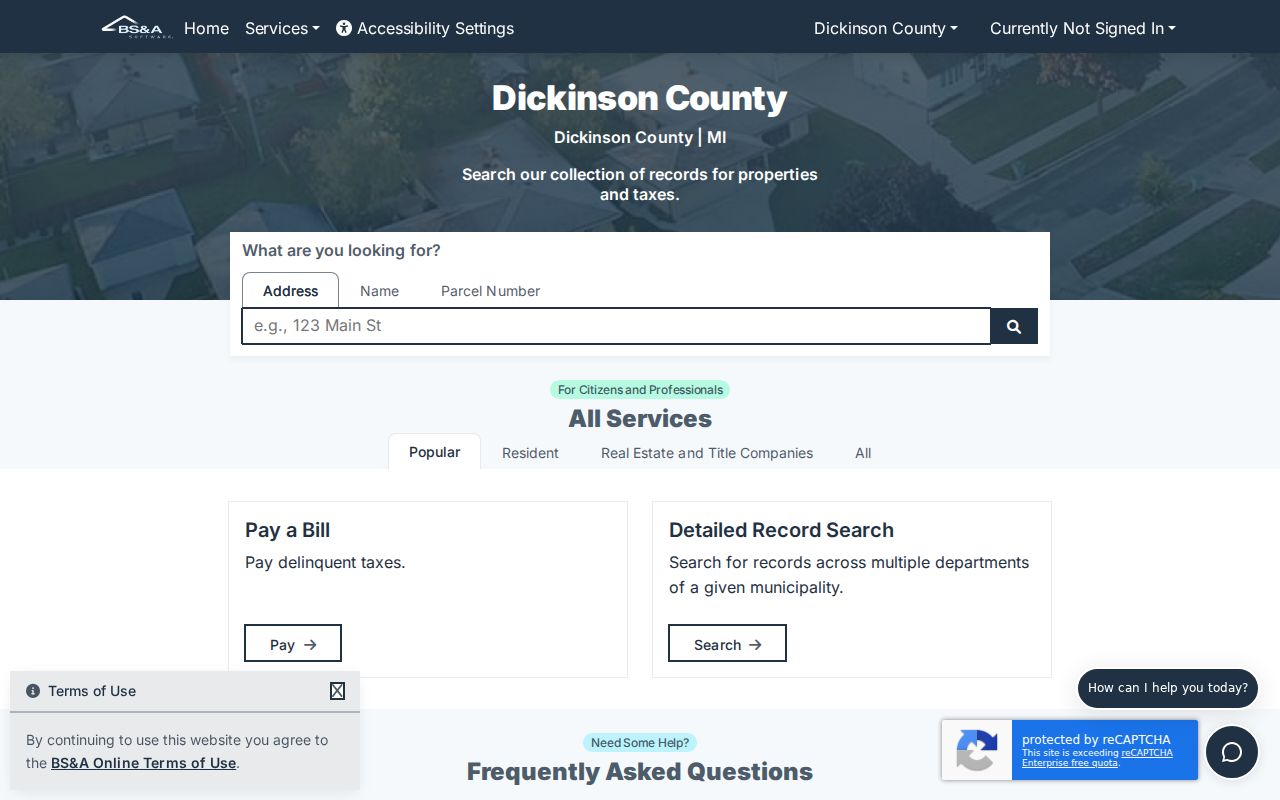
Keep tax year, municipality, parcel number, and exact labels with each result.
Locate a Dickinson County Property Value
Start in BS&A and keep every label intact. City assessors maintain the local rolls, county Equalization supplies broader context, and the recorder holds the transfer instruments behind each value.
- Search by address and confirm municipality and parcel.
- Copy assessed, equalized, taxable, and true-cash labels exactly.
- Record roll year and public exemption or transfer notes.
- Use deed consideration as a separate historic sale source.
- Assessed value
- The local estimate used in Michigan property taxation, generally one-half of true cash value.
- Market value
- The estimated true cash value, which is not automatically the latest sale price.
- Assessment ratio
- The relationship between assessed value and true cash value, generally 50 percent in Michigan.
Label Dickinson County's 2025 Value Snapshot
A 2025 county packet lists Dickinson County's total at $1,462,972,854, with Iron Mountain at $385,066,429, Kingsford at $210,297,600, and Norway City at $100,927,600. Confirm the measure first. Countywide context is never a parcel estimate.
Put Dickinson County Value Growth in Context
Local news reported taxable-value growth of 5.4 percent for 2025 and an estimated 4.7 percent for 2026. That pace is not a promise. Every parcel did not change by the same rate.
Note: Countywide tax-base growth is not a parcel appraisal and should never be applied as a flat rate.
Check the Roll Year for a Kingsford Property Value
State Tax Commission material reported 2024 audit deficiencies in Kingsford land-value work and online access, with some issues still noted in July 2025. Support was added for the 2026 roll. That finding does not apply to every parcel. Name the roll year and compare city data against county BS&A before drawing conclusions.
Explain a Dickinson County Post-Sale Value Change
Gather the key facts: old and new tax years, deed date, transfer type, assessed value, taxable value, and exemption flag. Michigan rules can uncap taxable value after transfer. The change often lands in the next calendar year. Exceptions exist, so ask the assessor for the official roll or correction history instead of treating a mismatch as misconduct.
What a Dickinson County Property Value Does Not Prove
An assessment exists for tax administration. It guarantees no current sale price, replacement cost, clean title, environmental condition, or legal boundary. Old sale amounts can mislead as well.
Value vs price. A Dickinson County assessed value is neither a current appraisal nor a promise of what a buyer will pay.
Audit a Dickinson County Property Value Difference
A careful comparison sheet starts with the basics. Record the parcel number, local unit, roll year, assessed value, state equalized value, and taxable value. Add the principal-residence flag if it is public. Sale date and deed consideration belong there too. Leave blank anything the live source does not show, which keeps true cash value from being mislabeled as an appraisal and taxable value from being read as a price. When two screens disagree, their "as of" dates usually explain it.
Dickinson County's BS&A portal offers several paths. They include All Records, Assessing, Delinquent Tax, Tax, Property Sale, and Detailed Record. Start with Assessing when the question is value. Address accepts an exact number or a range, while Name and Parcel Number work as fallback keys. A sale result adds context, though a mass-assessment field and an arms-length transaction are not the same measure.
For a recent transfer, line up deed date, transfer type, and the old and new tax years. Check construction or loss changes too. Splits and combinations matter as well. Michigan Treasury says taxable value can uncap in the next calendar year after a transfer, subject to exceptions, so ask the assessor for the official roll or correction history if a difference remains.
Read Countywide Dickinson Value Figures with Labels
A 2025 county agenda packet lists a Dickinson County total of $1,462,972,854 plus figures for each municipal unit, including Iron Mountain at $385,066,429, Kingsford at $210,297,600, and Norway City at $100,927,600. Confirm the measure before use. Assessed, taxable, and equalized are not interchangeable labels. Local reporting later described different taxable-value and equalized-value changes for the county. Those numbers show why labels and years matter. They offer no automatic adjustment for a house, shop, forest parcel, or vacant lot. No parcel shares the countywide rate.
Check the Source Year for a Kingsford Property Value
State Tax Commission materials reported Kingsford deficiencies in land-value determinations and online access from a 2024 audit. Some issues remained in July 2025. Assessment support was added for the 2026 roll. That finding does not describe every parcel. Instead, label the roll year and reconcile city assessment data, county BS&A, and relevant commission material whenever a value matters.
Know which document you are reading. A county tax roll is not a municipal study. Kingsford's land-value and economic-condition-factor work names Ford Addition as a valuation neighborhood. But a neighborhood study is not a sale appraisal for each home inside it. Write down the study year, class, and neighborhood label first. Then compare those fields against the subject parcel's own roll entries. The source year matters even more for Kingsford because of State Tax Commission follow-up. Even so, that follow-up does not mean every assessment in the city is wrong.
Norway's assessor page lists helpful fields. These include legal description, state equalized value, taxable value, square footage, year built, lot size, and maps. The page also states that property information is updated with each deed. Those fields explain why a quick price comparison can mislead. Two parcels can differ in size, improvements, deed timing, or taxable-value history. The same page offers an inspection or FOIA route. When a field is disputed, request the official record behind it. Do not estimate a missing value from nearby property.
Treat the countywide news figures with equal care. Reported taxable-value increases mixed new construction, uncapping, and higher assessments. Equalized valuation moved at a different rate. A cap limits taxable-value growth under Michigan rules. It does not cap true cash value. Nor does it guarantee that a transferred parcel keeps the prior owner's taxable path. Combine the dated parcel roll, the transfer type, and state guidance before drawing conclusions. Never multiply last year's value by a countywide percentage and call the result official.
Sale consideration deserves separate verification. Search the Register of Deeds for the transfer tied to the same legal description. Record the deed date, recording date, parties, and stated consideration if it appears. A family transfer, estate conveyance, multi-parcel deed, or land contract may not reflect an open-market price. The same is true for a deal with unusual terms. Index entries can omit details that show only in the recorded image. Treat the stated amount as historical evidence. For a current market opinion, obtain an appraisal.
If city, county, and recorder sources still conflict, file a focused assessor request. Include the parcel number, municipality, tax years, each copied value label, and source dates. Add the deed reference and any split or combination clue. Ask for the public roll. Ask also for the transfer or correction history and an explanation of the maintained field. Do not call the mismatch fraud without evidence. Independent refresh schedules often explain what first looks like an error. Different statutory value concepts do too.