
Fields in Dickinson County Property Tax Records
The Dickinson County BS&A portal is the county's landing spot for property, tax, and delinquent-record lookups. Read each figure with its tax year and municipality.
| Field | What It Shows | Where |
|---|---|---|
| Assessed value | Generally 50% of true cash value under Michigan rules | Local assessor |
| State equalized value | Equalized assessment measure | Assessment roll |
| Taxable value | Value used with millage to calculate tax | Assessment and tax record |
| PRE status | Principal Residence Exemption classification | Assessment record |
| Bill and delinquency | Tax year, payment status, and later county delinquency | Municipality and Treasurer |
A sale price is evidence, not an automatic assessment. Michigan caps taxable value until a qualifying transfer uncaps it the following year, subject to statutory exceptions.
Dickinson County's Tax Search Entry
The BS&A search page supports address, name, and formatted parcel-number modes. Keep the punctuation, leading zeroes, tax year, and municipality intact.
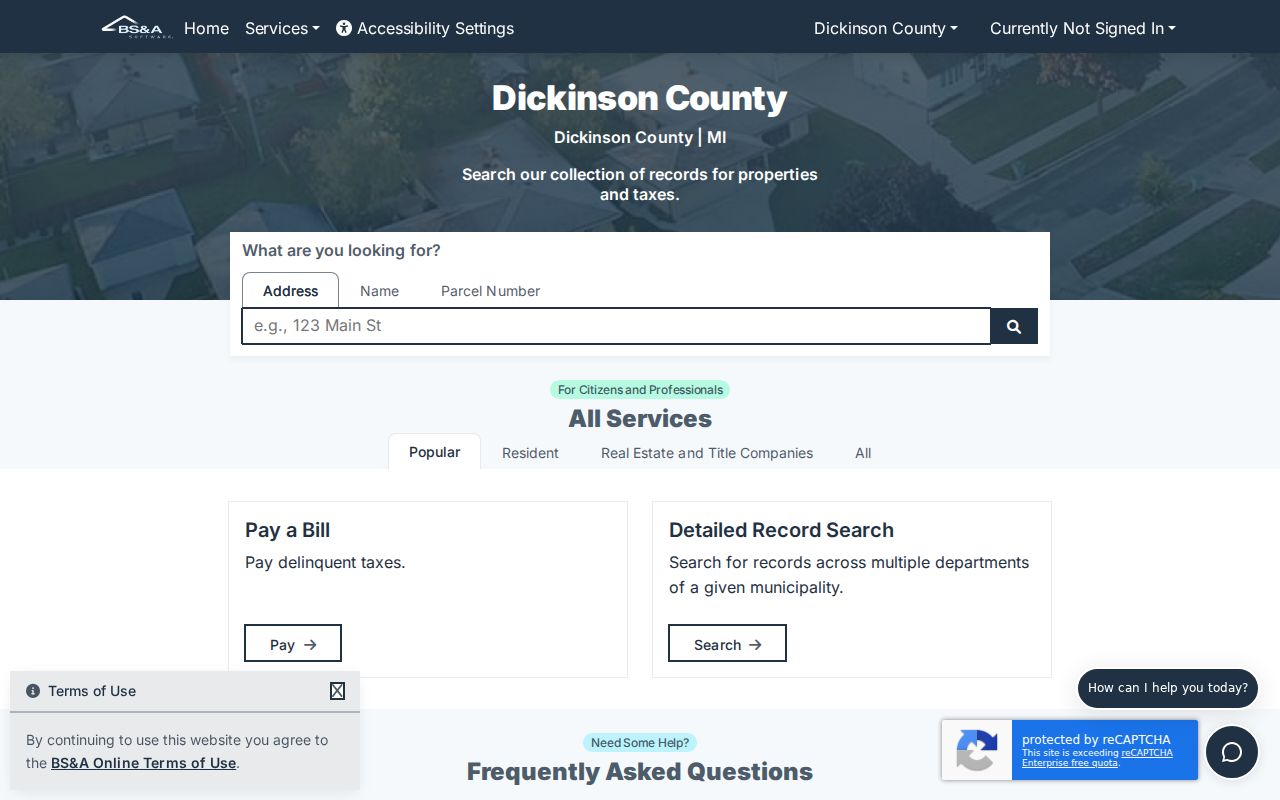
The screen spans assessment and delinquent-tax functions, so confirm official status with the office responsible for that tax year.
Proposal A, PRE, and Transfer Uncapping
Michigan Treasury explains that a qualifying transfer generally uncaps taxable value the following calendar year. Uncapping does not touch the assessment itself. Assessed and state equalized value generally equal 50% of true cash value, which is not automatically the sale price. The Principal Residence Exemption can remove up to 18 mills of local school operating tax for eligible owner-occupied property. A PRE flag is a classification. It does not prove occupancy on every historic date.
Look Up a Dickinson County Tax Bill
Current municipal taxes can precede county delinquency. The Dickinson County Treasurer receives delinquent taxes, maintains rolls, issues statements, and serves as the foreclosing governmental unit.
- Search BS&A by address, then repeat with the exact parcel number.
- Record the tax year, assessment fields, bill status, and municipal unit.
- Compare PRE and transfer information on the assessment record.
- Confirm delinquency, forfeiture, foreclosure, or excess-proceeds status with the Treasurer.
- Assessed value
- The assessor's value measure, generally half true cash value.
- Millage
- Tax per $1,000 of taxable value.
- PRE
- Michigan's qualifying principal-residence school operating exemption.
- Tax lien
- The governmental claim arising from unpaid property tax.
Delinquency Is Not Foreclosure
Michigan Treasury describes three stages: delinquency begins March 1 in Year 1, forfeiture occurs March 1 in Year 2, and foreclosure becomes effective with the end of redemption on March 31 in Year 3. Later auctions may follow. Request the notice, certificate, petition or judgment, auction record, and transfer status from the Treasurer. A portal flag is not proof. It does not establish the final stage.
Dickinson's Recent Value Context
Local reporting put the 2025 taxable-value increase near 5.4%. Another 4.7% was estimated for 2026, with equalized valuation projected up 8.8%. Countywide measures say nothing about one parcel's value. Audit any discrepancy against the source year, APN, PRE flag, deed transfer, and any split or new construction.
Dickinson County Tax Status Requests
Current tax and delinquent tax are separate records. The County Treasurer receives delinquent taxes from cities and townships. The Treasurer maintains the tax rolls and acts as the foreclosing governmental unit. Start in the Delinquent Tax scope of BS&A. Ask the Treasurer for an official status when payment, redemption, or a transfer depends on the answer. Include the parcel number, municipality, owner label, and each tax year.
After foreclosure, public files may include notices and court material. They may also include auction or transfer records and excess-proceeds information. Michigan Treasury identifies Form 5743 for certain claims tied to foreclosures after December 22, 2020. That claim is generally due July 1 after foreclosure. Rules depend on the date. For the current auction calendar or a historic sale list, contact the Treasurer. Do not rely on an old notice.
The Treasurer also certifies that no delinquent taxes are due on warranty deeds. The same certification applies to land contracts. That service is a tax-status function only. It does not replace recording. It does not establish title or settle another lien's effect.
Appeal a Dickinson County Assessment
Start local. The city or township assessor holds the Board of Review calendar. Compare classification, dimensions, improvements, transfer date, and exemption status against deeds, surveys, photographs, and comparable records; keep the notice and follow the municipality's current filing method.
Appeal window. There is no single countywide municipal deadline in the research. Confirm the applicable Board of Review dates immediately; missing the required filing or session can limit the available remedy.
Use the City, County, and State Tax Trail
Start a current Dickinson County property tax search at the local level. The city or township assessor keeps the assessment record and handles local appeals. For discovery by address, name, or parcel, County BS&A is the working tool. The Treasurer then carries the heavier load: delinquent taxes handed over from municipalities, the county tax rolls, statements, supplemental bills after homestead denials, and certifications that no delinquent tax stands behind a warranty deed or land contract. The same office runs tax reversion and holds excess proceeds.
Write the Treasurer at 705 S Stephenson Ave., PO Box 609, Iron Mountain, MI 49801, or call 906-774-8130. Give the parcel number, legal description, municipality, owner label, and each tax year you need. Request tax history, delinquency, forfeiture, foreclosure, auction, transfer, and excess-proceeds documents separately. A clean current-tax screen is not the same as a delinquency certification.
Dickinson County's Three-Year Delinquent-Tax Timeline
Michigan Treasury lays out the statewide foreclosure path under MCL 211.78a–m. Dickinson County follows the same clock. The tax first turns delinquent on March 1 of Year 1. Statutory charges and notices stack on after that. Year 2 brings forfeiture on March 1. An April forfeiture certificate, a May title search, and a June 15 Circuit Court petition follow. Forfeiture, though, is still not foreclosure. The owner of record keeps rights until the final stage.
Year 3 is when foreclosure takes effect, and redemption closes on March 31. Auctions may follow in July or November, and unsold parcels can later transfer to a governmental unit. Verify every parcel date with Dickinson County. Request the notice, certificate, petition, judgment, auction listing, and recorded conveyance. Do not trust a portal label to tell the whole story.
Michigan Treasury identifies Form 5743 for certain excess-proceeds claims after December 22, 2020. It is generally due July 1 following foreclosure. The rules shift depending on that date. Get the current form and instructions from the Treasurer or an official state resource. Steer clear of unverified third-party claim solicitations.
Audit a Dickinson Tax-Value Mismatch
Write down the city lookup date, the county BS&A date, the APN, tax year, owner label, assessed value, SEV, taxable value, PRE flag, and payment status. Then compare the latest deed and its transfer type. Michigan law can uncapping a sale into the following year's taxable value. Meanwhile, a monthly municipal refresh, new construction, a correction, or a split or combination can leave two screens disagreeing for a while. Neither screen is necessarily wrong. They may simply be answering on different dates.
A 2025 county agenda packet breaks out separate municipal valuation units. These cover Iron Mountain, Kingsford, Norway City, the townships, and the county total. Before quoting any aggregate, pin down whether it measures assessed, equalized, or taxable value. Or ask whether it is some other budget figure. Countywide growth never justifies an individual parcel assessment by itself.
Note: Carry the roll year and source date in every Dickinson County property tax comparison, since undated values invite a false discrepancy.
Assemble Evidence for a Dickinson Assessment Review
Begin with the assessment notice and the property card. Check land classification, lot dimensions, square footage, and year built. Also check improvements, condition assumptions, transfer date, exemption coding, and any recent division or combination of the parcel. Compare only sales or records that genuinely match the property type and the valuation date. A deed price can matter. But Michigan guidance says an assessor cannot simply set true cash value equal to that sale price.
Norway's assessor page names legal descriptions, state equalized value, taxable value, square footage, year built, lot size, and maps as maintained fields. It also notes that property information updates with each deed. Other municipalities expose a different set on a different schedule. Ask the responsible assessor for the official card. Ask for the correction or Board of Review route too. Do not assume one city's online practice governs the whole county.
Payment questions and value questions travel on separate tracks. Direct current tax to the municipal treasurer. After delinquency transfers, direct it to the Dickinson County Treasurer. For ownership, use the latest recorded deed. Keeping these questions apart builds a cleaner appeal record. It also keeps tax data from being mistaken for title proof.
Dickinson County Tax Status Requests
Current tax and delinquent tax are separate records. The Dickinson County Treasurer receives delinquent taxes from cities and townships. The Treasurer maintains the tax rolls and acts as the foreclosing governmental unit. Start in the Delinquent Tax scope of BS&A. But when payment, redemption, or a transfer rides on the answer, ask the Treasurer for official status. Include the parcel number, municipality, owner label, and each tax year in question.
After foreclosure, the file may hold notices. It may also hold court material, auction or transfer records, and excess-proceeds information. Michigan Treasury identifies Form 5743 for certain claims tied to foreclosures after December 22, 2020. It is generally due July 1 after foreclosure. Those rules depend on the date. Dickinson County publishes no stable historic auction sale list. So contact the Treasurer for the current calendar rather than relying on an old notice.
The Treasurer also certifies no delinquent taxes on warranty deeds and land contracts. That is a tax-status function only. It does not replace recording, establish title, or settle any other lien.